Stage Review Henry V

Updated: Apr 11
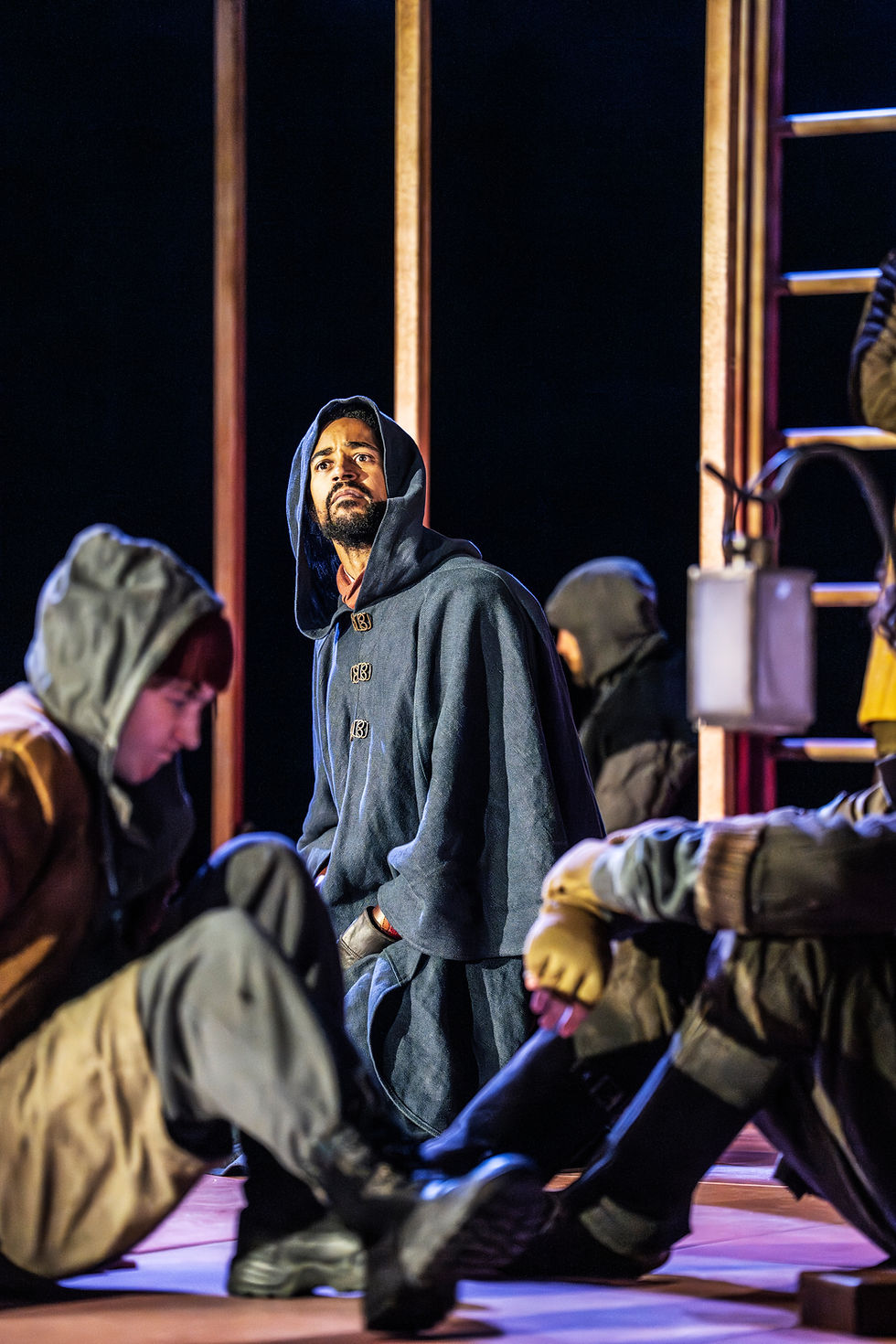
Henry V
⭐⭐⭐⭐
by William Shakespeare
Directed by Tamara Harvey
Background
Shakespeare's history play, Henry V theatrically drip feeds a tale from the middle ages; one which tells of strong bonds existing between England's nobility and the common people.
Based on factual events and on real people including members of the English and French royal families for example, and those attached to court life. A manipulative Archbishop of Canterbury; high ranking military personnel and figures in public office from both sides of the English channel. Of course, some personalities and roles were changed (Shakespeare exercising his creative license) however, he breathed life into the fictional characters of the play too.

The Welsh officer, Fluellen for instance is a made up person, but he is a larger than life key character of the play, as are the mischievous Pistol, Nym and Bardolph from the tavern, played with wonderful humour and amusing physical characterisations the scenes dedicated to these characters lighten the mood a little and so are welcomed and enjoyed.

Overview
Henry of Monmouth (aka Harry) was wayward before he came to the throne. From the mouths of the tavern folk came stories of the young prince being good and convivial company amongst them, the commoners, with the likes of the old knight, Sir John being more than a drinking buddy; he was a friend.
After his father dies and Henry becomes king, there is immediate talk of him making a claim for the French throne. A gift of tennis balls in a box from Dauphin, the son of Charles VI of France, mocks him, as it gives a sarcastic nod to the 'messing around' of Henry's youth and is a challenge to his ability to behave responsibly in his role as monarch.
The Archbishop offers up the money to fight a war with France, though not everyone is enrolled in the idea. Henry orders three traitors, namely Cambridge, Lord Scroop, and Sir Thomas Grey, to hang for treason before they set sail from Southampton.
Once on French soil two significant, Lancastrian phased battles of the one-hundred years' war between England and France takes place first at Harflour and then Agincourt.
The English are victorious at Harflour but are an ailing and depleted 'band of brothers'. The night before the battle of Agincourt, in the glove swapping scene, it weighs heavy on the ambitious Henry (in disguise) when soldier, Williams says the King should be solely responsible for the deaths and suffering of ordinary men in battle. Henry argues that the King is only responsible for the war itself and that he should not be blamed for the fate of the souls who may fall foul.
The battle at Agincourt (on Saint Crispin's Day) resulted in a win for Henry and England against all odds. The strategic positioning and weaponry used and soldiers willing to fight tooth and nail in the mud against a French army made up of noblemen mostly, many on horseback, proved a winning ploy.
Henry goes on to take the hand of Katherine, daughter of the French king in marriage and is crowned King of England and of France.
Shakespeare took the truth of the outcome and constructed scenes and speeches within the play's five Acts to arrive at a key principle idea that this was a victory by the common people and for English patriotism.
Comment
Henry's general speech is in prose and a series of monologues and the interjection of the long, rousing speeches are in poetic verse which Shakespeare saves for scenes that require more dramatic effect. Oddly, many of said scenes that are hugely intense in other comparable performances of Henry V, are played out in calm ways in this instance, so much so, they hardly impact at all. This production seems to have concentrated much of its energies on the movement work and fight direction. The moveable, scaffolding framework is an awesome build and serves its purposes well.

Actor, Alfred Enoch (Henry) is slightly removed from the action at any given time, even when the stage is a chaotic space of intense fighting. When the battle scenes are staged at floor level, Henry is perched up high. If the action is all around, Henry is somewhere on the peripheral.
We hear him enough - because Henry is the scene stealer; the centrepin; Henry is even The Chorus. Enoch's performance is tight, he is word perfect and engaging. However, this Henry is not profound. Enoch adopts, in his portrayal of the main man, the stance and attitude of a young king who lacks wisdom and personality. He plays Henry as someone who has dropped his former playfulness and who courts a more serious side. The direction sees Henry keeping his distance on purpose, therefore, and though it seems intentionally so, this Henry lacks any kind of outward emotional expression.
In terms of falling on the right or wrong side of history, Henry V is a confusing play. As the saying goes (and it is not one by Shakespeare) 'Alls Fair in Love and War', perhaps we just shouldn't over think it, and so, bearing that in mind it would be a shame for Shakespeare fans and theatre goers to miss this interesting take on Henry V; at The Royal Shakespeare Theatre until 25 April 2026
Henry V Stage Review by theatre critic, Debra Hall who attended the 1.15pm performance at The Royal Shakespeare, Stratford Upon Avon on Thursday 09 April 2026.
REFERENCES
Asker, D. Henry V Images 20 Royal Shakespeare Company March 2026
RSC printed programme HENRY V by William Shakespeare
RSC Royal Shakespeare Company https://www.rsc.org.uk/


Comments